 | |||
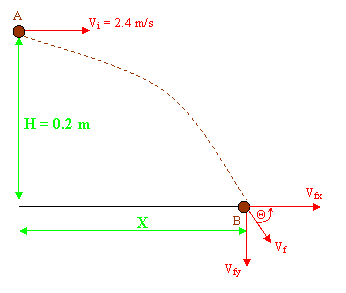
| Vi = Initial velocity Vf = Final velocity Vx = Horizontal velocity component Vy = Vertical velocity component a = Acceleration t = time H = Initial height X = Horizontal displacement | |||
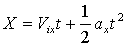
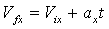
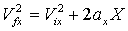
| For the horizontal motion, the equations are | |||
| |||
| Remember horizontal acceleration is always zero for this problem ( ax = 0). So we can rewrite above equations for horizontal motion as | |||
| |||
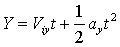
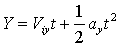
| For the vertical motion, the equations are | |||
| |||
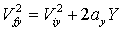 Equation (5) | |||
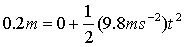
| Apply equation (3) for vertical motion from point A to B | |||
 | |||
| At the initial position A, there is no velocity component on vertical direction, so it is zero Vfy = 0 | |||
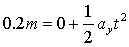 | |||
 | |||
 | |||
 | |||
| t = 0.2 s | |||
| Pool ball hit the ground in 0.2 seconds. | |||
| Apply equation (1) for horizontal motion from point A to B | |||
 | |||
 | |||
| X = 0.48 m | |||
| Horizontal displacement 0.48 meters. | |||
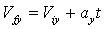
| Lets calculate the final velocity and the angle Θ with horizontal pool ball going to hit the ground. Apply equation (4) for vertical motion from point A to B | |||
 | |||
 | |||
 | |||
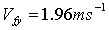 | |||
| Calculate final velocity component. | |||
| Final velocity on horizontal directions can be easily obtained from equation (2) | |||
 | |||
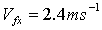 | |||
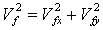
| Now we can find the final velocity using trigonometry | |||
 | |||
 | |||
 | |||
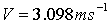 | |||
| Final velocity of the pool ball when it hit the ground is 3.098 m/s | |||
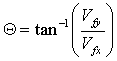
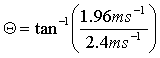
| Calculate impact angle | |||
 | |||
 | |||
 | |||
 | |||
| Θ = 39.24 | |||
| Angle of incident 39.24 degrees. |