 | |||
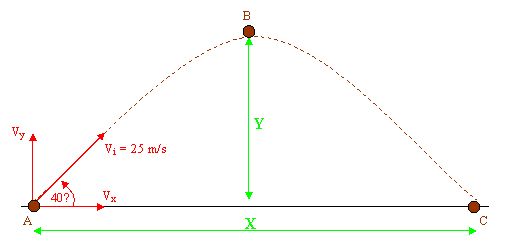
| Vi = Initial velocity Vf = Final velocity Vx = Horizontal velocity component Vy = Vertical velocity component a = Acceleration t = time H = Peak height X = Horizontal displacement | |||
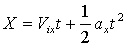
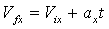
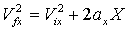
| For the horizontal components of motion, the equations are | |||
| |||
| Remember horizontal acceleration is always zero for this problem ( ax = 0). So we can rewrite above equations for horizontal motion as | |||
| |||
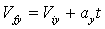
| For the vertical components of motion, the equations are | |||
| |||
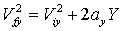 Equation (5) | |||
| Apply equation (4) for vertical motion from point A to B | |||
 Equation (4) | |||
| At the maximum height there are no vertical velocity, so it is zero Vfy = 0 | |||
 | |||
| To reach maximum height it takes only half of the full flight time | |||
 | |||
 | |||
 | |||
| t = 3.28 s | |||
| Time of flight 3.28 seconds | |||
| Apply equation (1) for horizontal motion from point A to C | |||
 Equation (1) | |||
 | |||
| X = 62.82 m | |||
| Horizontal displacement 62.82 meters. | |||
| Apply equation (5) for vertical motion from point A to B | |||
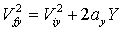 Equation (5) | |||
 | |||
 | |||
 | |||
| Y = 13.17 m | |||
| Peak height 13.17 meters. | |||